In wound care, breakthroughs in materials science, bioengineering, and digital monitoring are redefining how wounds are treated and healed. At West Coast Wound Care, we do everything we can to provide the most advanced care possible. As such, that means being on top of what’s new, in this year or any other. This can include treatment, wound dressings, and so much more.

Smart Dressings: From Passive to Responsive
Traditional dressings act as passive barriers: they protect the wound, absorb exudate, and maintain moisture. New advanced “Smart Dressings” are designed to go several steps further. These are dressings embedded with sensors, microelectronics, or responsive materials that monitor or even intervene in the wound environment in real time.
According to this article “A review on smart dressings with advanced features,” these advancements “have enabled real-time monitoring, targeted therapy, and controlled release of medications,” among other benefits.
What makes these “Smart dressings” “smart,” in part, is that they can pick up on so much. There have been reports that some of these can pick up pH changes (a potential sign of early infection), as well as temperature shifts, oxygenation, and more.
Some dressings can drain excess fluid on their own, while others can trigger controlled release of approved drugs/antimicrobial agents. As these “Smart dressings” can be calibrated to being sensitive to changes in a patient’s condition, they can help to provide better, more targeted, and more timely care.
At West Coast Wound Care, when a patient’s wound warrants it, we evaluate whether a smart dressing is advantageous in their case. Our wound care specialist team is trained to select sensor-enabled dressings (where available) and integrate the data into our treatment protocols.
“Bioengineered skin substitutes” may sound like something from science fiction. However, it’s a form of wound dressings that can be used for more effective healing. When a wound fails to reduce in size over several weeks under standard care, guidelines increasingly recommend moving to skin substitutes as an advanced therapy.
When a wound resists conventional therapy or becomes chronic, bioengineered skin substitutes can play a transformative role. These are scaffolds, cellular or acellular constructs, or living tissue grafts that bridge the gap between injured tissue and full repair. This article, “Skin substitutes: as treatment for chronic wounds: current and future directions” goes into greater detail.
Essentially, these versions are frameworks made of collagen, extracellular matrix components, or synthetic polymers. They don’t carry live cells, but they provide structure for the body’s cells to migrate, proliferate, and remodel tissue. Those are many big words which all mean that they can provide for better healing outcomes.
Those are far from all that’s available. Some substitutes include living cells (keratinocytes, fibroblasts) or multiple layers that approximate skin architecture (dermis + epidermis).
One of their key advantages is that they can be applied without creating a donor site on the patient (i.e. no skin harvesting) and accelerate wound closure.
At West Coast Wound Care, we evaluate chronic wounds in our clinics or during mobile visits for suitability for these therapies. Our wound care specialists determine which treatments are appropriate.
Beyond smart dressings and skin substitutes, additional innovations are emerging to push wound care forward. For example, some dressings are engineered to respond to changes in the wound microenvironment. For example, a hydrogel that responds to temperature or pH to release antimicrobials on demand, or a photodynamic dressing that generates reactive oxygen species when exposed to light to kill bacteria is currently being experimented with.
One new polymer derivative builds UV-cured and photodynamic antimicrobial capability into a fiber structure. Under light exposure, it triggers microbial kill while remaining biocompatible.
Not every new treatment will be right for each patient. However, we can tell you that, here at West Coast Wound Care, our pros always use the right treatments for our patients.
There have been plenty of advancements in wound tracking in addition to wound dressings. Still another frontier is digital wound tracking. Seemingly every day, tech becomes available to enable patients to take better, more detailed photos of their wounds.
Some can even be segmented with AI models to report symptoms and more.
At West Coast Wound Care, we study and learn all there is to know about these new advancements. This is a significant portion of how we deliver care.
Our clinical locations are stocked with advanced materials so when a patient presents with a stubborn or complex wound, our wound care specialist team can evaluate and provide appropriate care immediately.
In our mobile wound care service, we bring clinical-grade solutions to your door. That means if a patient’s wound requires it, we can apply and monitor those technologies just as effectively in the field as in the clinic.
We always assess each wound’s particular needs—depth, perfusion, infection risk, exudate levels, and so much more—all to select the dressing or substitute that gives the wound the best environment for recovery. We don’t simply apply the “latest gadget”; we choose based on sound criteria and integrate monitoring into follow-up care.
We believe that the best healing comes when cutting-edge science meets personalized care. The innovations emerging in wound dressing technology are reshaping how we approach wound recovery. For patients dealing with acute or chronic wounds, these tools offer new hope and faster, safer healing trajectories.
Whether in our clinics or via mobile wound care visits, we’re ready to evaluate your wound, recommend the right advanced technologies, and guide you toward optimal recovery. If you or a loved one are managing a wound that seems stalled, showing signs of infection, or not progressing as expected, please reach out to us. Schedule a free appointment today.
When it comes to better wound care, hospitals and skilled nursing facilities (SNFs) often provide critical support in the early stages of treatment. These facilities play a vital role in ensuring comfort, stabilizing conditions, and preventing complications. However, many hospitals and SNFs face challenges they aren’t always equipped to fully heal. That doesn’t mean that you simply have to go without. Through our partnerships with SNFs, we can provide the kind of healing that makes it so that you and yours don’t have to go through readmissions.
Wound healing is a specialized process that requires a blend of advanced techniques, expert oversight, and consistent care. By working alongside SNFs, we’re able to provide focused and holistic wound care services aimed at promoting faster recovery, reducing hospital readmissions, and so much more.
Hospitals excel at treating acute, life-threatening conditions and stabilizing patients in critical moments. Similarly, SNFs provide essential post-acute care, offering support like physical therapy, medication administration, and monitoring. While these institutions are invaluable, their services are often not designed to address the complexities of wound healing.
Wounds, particularly chronic ones, require specialized care plans and long-term strategies that go beyond the immediate scope of most hospitals and SNFs. Key challenges include:
This gap in care can increase the likelihood of patients experiencing complications, delayed healing, and readmissions all of which can be emotionally taxing for patients and financially draining for healthcare systems.
Wound healing requires a deep level of knowledge and experience that is often not available in general healthcare settings. Our team of experts includes specially trained wound care technicians who bring advanced skills to the table. We’re equipped to manage complex conditions such as pressure ulcers, diabetic foot ulcers, and surgical wounds.
By partnering with SNFs, We can bridge the gap in expertise, ensuring that patients receive the focused attention their wounds need. This can significantly improve healing outcomes and reduce the risk of preventable complications.
One of the benefits of our mobile wound care services is the ability to meet patients where they are. For SNFs, this means our technicians can visit patients directly within the facility, offering personalized care without requiring patients to travel.
During on-site visits, our technicians perform detailed assessments, develop tailored treatment plans, and monitor progress through regular follow-ups. Services also include skin sweeps, which help identify new or emerging wounds early on, preventing them from worsening.
The challenge of effective care doesn’t end when a patient is discharged from a hospital or SNF. Many individuals are sent home with instructions to manage wounds independently, but without the right support, these wounds can regress. Whether at home or in outpatient settings, with our care, patients can continue their healing journeys under expert supervision, benefiting from added peace of mind and continuity of care.
Hospital readmissions are often a result of complications or worsening conditions that weren’t fully addressed during initial care. For wounds, this could mean infections, poor healing, or the formation of new pressure ulcers.
By introducing proactive and specialized wound care within SNFs, we can stop that from happening. This not only benefits individual patients by improving their quality of life and accelerating recovery but also helps the broader healthcare system by reducing avoidable hospital stays.
Partnerships between our wound healing techs and SNFs go beyond individual patients. Together, we create a system that supports everyone involved in the care process, including staff, patients, and their families.
Collaborating alleviates some of the burden on overworked SNF staff by giving them access to specialists who can provide specialized types of wound healing that they may not be able to. This allows staff to focus more effectively on their other responsibilities, improving overall efficiency within the facility.
When patients and their families see that SNFs have partnered with dedicated care experts, it reinforces their trust and confidence in the care provided. Trust is a key factor in patient satisfaction and can influence the reputation of the facility.
Our role typically doesn’t stop at clinical care. We can also provide education and resources to SNF staff, helping them better understand best practices for wound prevention and early intervention. This shared knowledge empowers facilities to build a culture of proactive health management.
Since the beginning, our mission has been about so much more than just healing wounds. It’s about fostering a community of care that brings together hospitals, SNFs, and patients to achieve shared goals. This care model emphasizes accessibility, affordability, and holistic healing, ensuring that every patient has the opportunity to recover in the best way possible.
SNFs and hospitals don’t have to go it alone. We offer the specialized expertise and personalized attention necessary to make lasting changes in patient outcomes and healthcare processes. From helping reduce readmissions to delivering peace of mind for families, we’re here to help all involved. To see how we can help you, reach out today.
[fusion_builder_container hundred_percent=”no” equal_height_columns=”no” menu_anchor=”” hide_on_mobile=”small-visibility,medium-visibility,large-visibility” class=”” id=”” background_color=”” background_image=”” background_position=”center center” background_repeat=”no-repeat” fade=”no” background_parallax=”none” parallax_speed=”0.3″ video_mp4=”” video_webm=”” video_ogv=”” video_url=”” video_aspect_ratio=”16:9″ video_loop=”yes” video_mute=”yes” overlay_color=”” video_preview_image=”” border_color=”” border_style=”solid” padding_top=”” padding_bottom=”” padding_left=”” padding_right=”” type=”legacy” admin_toggled=”no”][fusion_builder_row][fusion_builder_column type=”2_3″ layout=”1_1″ background_position=”left top” background_color=”” border_color=”” border_style=”solid” border_position=”all” spacing=”yes” background_image=”” background_repeat=”no-repeat” padding_top=”” padding_right=”” padding_bottom=”” padding_left=”” margin_top=”0px” margin_bottom=”0px” class=”” id=”” animation_type=”” animation_speed=”0.3″ animation_direction=”left” hide_on_mobile=”small-visibility,medium-visibility,large-visibility” center_content=”no” last=”false” min_height=”” hover_type=”none” link=”” border_sizes_top=”” border_sizes_bottom=”” border_sizes_left=”” border_sizes_right=”” first=”true” spacing_right=”2.6666666666666665%”][fusion_text columns=”” column_min_width=”” column_spacing=”” rule_style=”default” rule_size=”” rule_color=”” content_alignment_medium=”” content_alignment_small=”” content_alignment=”” hide_on_mobile=”small-visibility,medium-visibility,large-visibility” sticky_display=”normal,sticky” class=”” id=”” margin_top=”” margin_right=”” margin_bottom=”” margin_left=”” font_size=”” fusion_font_family_text_font=”” fusion_font_variant_text_font=”” line_height=”” letter_spacing=”” text_color=”” animation_type=”” animation_direction=”left” animation_speed=”0.3″ animation_offset=””]
Skin tears are a common and often painful type of wound, particularly among the elderly population. They can occur in various settings, from accidents at home to healthcare facilities. Understanding what a skin tear is, how to properly care for it, and the factors affecting its healing process are essential for proper healing and recovery.
 A skin tear is a superficial wound characterized by the separation of the layers of the skin, typically the epidermis and dermis, caused by shear, friction, or trauma. These wounds are often jagged or irregular in shape and can vary in size and depth. Skin tears are especially prevalent in elderly individuals due to the natural aging process, which makes their skin thinner and more fragile.
Skin tears are generally categorized into three main types based on their specific characteristics:
Proper wound care is essential for the treatment and healing of skin tears. Here are a few key steps to follow if you have suffered a skin tear:
Choosing the right dressing for a skin tear plays an important role in effective wound care. Your wound care specialist can offer recommendations for the best dressing for your circumstances but some of the more common ones may include:
Whether a skin tear should be covered or left uncovered depends on several factors such as:
Several factors can contribute to a skin tear not healing as expected:
 Knowing when to visit a wound care center is important for individuals with skin tears or any other serious wound that may require specialized care. While many skin tears can be effectively managed at home or in a primary care setting, there are certain situations where seeking the expertise of a wound care center becomes necessary. Here are a few signs to watch out for that could mean it’s time to seek specialized care:
Preventing skin tears is a crucial aspect of maintaining skin health, especially in vulnerable populations like the elderly. Here are some key strategies to help prevent skin tears:
Skin tears are common and require careful attention and proper care to ensure they heal effectively. Understanding their causes, types, and the appropriate wound care measures is essential for proper healing and recovery. If you or someone you know is concerned about a skin tear or have a wound that hasn’t shown signs of improvement the specialized team at West Coast Wound Center can help. Book an appointment today.
[/fusion_text][/fusion_builder_column][fusion_builder_column type=”1_3″ layout=”1_3″ spacing=”” center_content=”no” link=”” target=”_self” min_height=”” hide_on_mobile=”small-visibility,medium-visibility,large-visibility” class=”” id=”” hover_type=”none” border_color=”” border_style=”solid” border_position=”all” border_radius=”” box_shadow=”no” dimension_box_shadow=”” box_shadow_blur=”0″ box_shadow_spread=”0″ box_shadow_color=”” box_shadow_style=”” padding_top=”” padding_right=”” padding_bottom=”” padding_left=”” margin_top=”” margin_bottom=”” background_type=”single” gradient_start_color=”” gradient_end_color=”” gradient_start_position=”0″ gradient_end_position=”100″ gradient_type=”linear” radial_direction=”center center” linear_angle=”180″ background_color=”” background_image=”” background_image_id=”” background_position=”left top” background_repeat=”no-repeat” background_blend_mode=”none” animation_type=”” animation_direction=”left” animation_speed=”0.3″ animation_offset=”” filter_type=”regular” filter_hue=”0″ filter_saturation=”100″ filter_brightness=”100″ filter_contrast=”100″ filter_invert=”0″ filter_sepia=”0″ filter_opacity=”100″ filter_blur=”0″ filter_hue_hover=”0″ filter_saturation_hover=”100″ filter_brightness_hover=”100″ filter_contrast_hover=”100″ filter_invert_hover=”0″ filter_sepia_hover=”0″ filter_opacity_hover=”100″ filter_blur_hover=”0″ last=”true” border_sizes_top=”0″ border_sizes_bottom=”0″ border_sizes_left=”0″ border_sizes_right=”0″ first=”false” spacing_left=”1.3333333333333333%”][fusion_widget_area name=”avada-blog-sidebar” title_size=”” title_color=”” background_color=”” padding_top=”” padding_right=”” padding_bottom=”” padding_left=”” hide_on_mobile=”small-visibility,medium-visibility,large-visibility” class=”” id=”” /][/fusion_builder_column][/fusion_builder_row][/fusion_builder_container]
[fusion_builder_container hundred_percent=”no” equal_height_columns=”no” menu_anchor=”” hide_on_mobile=”small-visibility,medium-visibility,large-visibility” class=”” id=”” background_color=”” background_image=”” background_position=”center center” background_repeat=”no-repeat” fade=”no” background_parallax=”none” parallax_speed=”0.3″ video_mp4=”” video_webm=”” video_ogv=”” video_url=”” video_aspect_ratio=”16:9″ video_loop=”yes” video_mute=”yes” overlay_color=”” video_preview_image=”” border_color=”” border_style=”solid” padding_top=”” padding_bottom=”” padding_left=”” padding_right=”” type=”legacy” admin_toggled=”no”][fusion_builder_row][fusion_builder_column type=”2_3″ layout=”1_1″ background_position=”left top” background_color=”” border_color=”” border_style=”solid” border_position=”all” spacing=”yes” background_image=”” background_repeat=”no-repeat” padding_top=”” padding_right=”” padding_bottom=”” padding_left=”” margin_top=”0px” margin_bottom=”0px” class=”” id=”” animation_type=”” animation_speed=”0.3″ animation_direction=”left” hide_on_mobile=”small-visibility,medium-visibility,large-visibility” center_content=”no” last=”false” min_height=”” hover_type=”none” link=”” border_sizes_top=”” border_sizes_bottom=”” border_sizes_left=”” border_sizes_right=”” first=”true” spacing_right=”2.6666666666666665%”][fusion_text columns=”” column_min_width=”” column_spacing=”” rule_style=”default” rule_size=”” rule_color=”” content_alignment_medium=”” content_alignment_small=”” content_alignment=”” hide_on_mobile=”small-visibility,medium-visibility,large-visibility” sticky_display=”normal,sticky” class=”” id=”” margin_top=”” margin_right=”” margin_bottom=”” margin_left=”” font_size=”” fusion_font_family_text_font=”” fusion_font_variant_text_font=”” line_height=”” letter_spacing=”” text_color=”” animation_type=”” animation_direction=”left” animation_speed=”0.3″ animation_offset=””]
When it comes to wound care, understanding the different methods of wound closure is crucial for proper healing and minimizing scarring. Stitches and sutures are commonly used techniques in medical practice to bring the edges of a wound together, allowing the body to mend itself. In this comprehensive guide, we share what you need to know about sutures and stitches, the healing process, and some important do’s and don’ts regarding wound care.
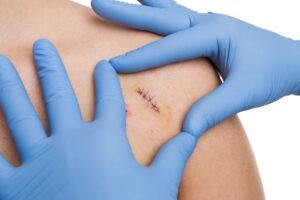 A suture, in medical terms, refers to the stitching or sewing together of the edges of a wound or incision. Sutures are typically made of sterile materials like thread or wire and are used to close wounds, promote healing, and reduce the risk of infection. They act as a temporary bridge to hold the wound edges close together until the natural healing process occurs.
There are several types of sutures available, each with its own characteristics and applications. Some of the most common types include:
“Sutures” and “stitches” are often used interchangeably, but they refer to slightly different concepts. Sutures are the actual threads or materials used to close wounds, while stitches refer to the act of sewing or suturing a wound. In essence, stitches are the technique, and sutures are the materials used for that technique.
Surgical staples are another common method of closing wounds or surgical incisions. They are generally made of stainless steel or titanium and resemble small, U-shaped clips. Surgical staples are often used in procedures involving the skin, gastrointestinal tract, and lungs. They offer several advantages, including speed and precision during closure.
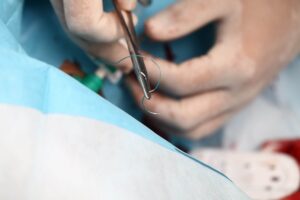 Determining when stitches are needed for a wound is crucial for proper healing and minimizing scarring. Generally, stitches might be recommended if:
Proper wound cleaning is essential to prevent infection and promote healing after stitches have been applied. Here are a few tips for keeping the wound clean:
Understanding the stitching healing process can help you better care for your wound.
Stitch removal is a common procedure that should be performed at a wound care center or by a specialist. Here’s how stitches are typically removed:
While it is possible to remove your own stitches under certain circumstances, it is generally not recommended. Wound care specialists are trained to perform this procedure safely and hygienically to minimize the risk of infection or complications.
Attempting to remove your own stitches may result in pain, injury, or improper removal, which can lead to infection or scarring.
After stitches are removed, it’s important to keep the wound clean and protected. In most cases, a wound care specialist will advise you to keep the wound covered with a sterile bandage or dressing for a few days to protect the healing tissue. Make sure to follow your specialist’s instructions for proper wound care and dressing changes.
After removal, proper wound care is still important to ensure the wound continues to heal well. Here are a few wound care tips to keep in mind:
Understanding the various aspects of stitches, sutures, and surgical staples is essential for effective wound care and optimal healing. Remember to follow your wound specialist’s recommendations and be patient as your body works to heal itself. If you have any concerns about your wound or the healing process, don’t hesitate to book an appointment at West Coast Wound Center.
[/fusion_text][/fusion_builder_column][fusion_builder_column type=”1_3″ layout=”1_3″ spacing=”” center_content=”no” link=”” target=”_self” min_height=”” hide_on_mobile=”small-visibility,medium-visibility,large-visibility” class=”” id=”” hover_type=”none” border_color=”” border_style=”solid” border_position=”all” border_radius=”” box_shadow=”no” dimension_box_shadow=”” box_shadow_blur=”0″ box_shadow_spread=”0″ box_shadow_color=”” box_shadow_style=”” padding_top=”” padding_right=”” padding_bottom=”” padding_left=”” margin_top=”” margin_bottom=”” background_type=”single” gradient_start_color=”” gradient_end_color=”” gradient_start_position=”0″ gradient_end_position=”100″ gradient_type=”linear” radial_direction=”center center” linear_angle=”180″ background_color=”” background_image=”” background_image_id=”” background_position=”left top” background_repeat=”no-repeat” background_blend_mode=”none” animation_type=”” animation_direction=”left” animation_speed=”0.3″ animation_offset=”” filter_type=”regular” filter_hue=”0″ filter_saturation=”100″ filter_brightness=”100″ filter_contrast=”100″ filter_invert=”0″ filter_sepia=”0″ filter_opacity=”100″ filter_blur=”0″ filter_hue_hover=”0″ filter_saturation_hover=”100″ filter_brightness_hover=”100″ filter_contrast_hover=”100″ filter_invert_hover=”0″ filter_sepia_hover=”0″ filter_opacity_hover=”100″ filter_blur_hover=”0″ last=”true” border_sizes_top=”0″ border_sizes_bottom=”0″ border_sizes_left=”0″ border_sizes_right=”0″ first=”false” spacing_left=”1.3333333333333333%”][fusion_widget_area name=”avada-blog-sidebar” title_size=”” title_color=”” background_color=”” padding_top=”” padding_right=”” padding_bottom=”” padding_left=”” hide_on_mobile=”small-visibility,medium-visibility,large-visibility” class=”” id=”” /][/fusion_builder_column][/fusion_builder_row][/fusion_builder_container]
[fusion_builder_container hundred_percent=”no” equal_height_columns=”no” menu_anchor=”” hide_on_mobile=”small-visibility,medium-visibility,large-visibility” class=”” id=”” background_color=”” background_image=”” background_position=”center center” background_repeat=”no-repeat” fade=”no” background_parallax=”none” parallax_speed=”0.3″ video_mp4=”” video_webm=”” video_ogv=”” video_url=”” video_aspect_ratio=”16:9″ video_loop=”yes” video_mute=”yes” overlay_color=”” video_preview_image=”” border_color=”” border_style=”solid” padding_top=”” padding_bottom=”” padding_left=”” padding_right=”” type=”legacy” admin_toggled=”no”][fusion_builder_row][fusion_builder_column type=”2_3″ layout=”1_1″ background_position=”left top” background_color=”” border_color=”” border_style=”solid” border_position=”all” spacing=”yes” background_image=”” background_repeat=”no-repeat” padding_top=”” padding_right=”” padding_bottom=”” padding_left=”” margin_top=”0px” margin_bottom=”0px” class=”” id=”” animation_type=”” animation_speed=”0.3″ animation_direction=”left” hide_on_mobile=”small-visibility,medium-visibility,large-visibility” center_content=”no” last=”false” min_height=”” hover_type=”none” link=”” border_sizes_top=”” border_sizes_bottom=”” border_sizes_left=”” border_sizes_right=”” first=”true” spacing_right=”2.6666666666666665%”][fusion_text columns=”” column_min_width=”” column_spacing=”” rule_style=”default” rule_size=”” rule_color=”” content_alignment_medium=”” content_alignment_small=”” content_alignment=”” hide_on_mobile=”small-visibility,medium-visibility,large-visibility” sticky_display=”normal,sticky” class=”” id=”” margin_top=”” margin_right=”” margin_bottom=”” margin_left=”” font_size=”” fusion_font_family_text_font=”” fusion_font_variant_text_font=”” line_height=”” letter_spacing=”” text_color=”” animation_type=”” animation_direction=”left” animation_speed=”0.3″ animation_offset=””]
Wound healing is a complex biological process that the body undergoes in response to tissue injury. Traditionally, wound management involved keeping the wound dry and exposed to air. However, in recent years, the concept of moist wound healing has gained significant attention among wound care specialists and healthcare professionals. Moist wound healing involves maintaining a controlled moist environment over the wound site, which in many cases, has been found to offer numerous advantages over the traditional dry approach.
In this article, we will explore the efficacy and benefits of moist wound healing as it compares to dry healing as well as its role in the healing process.
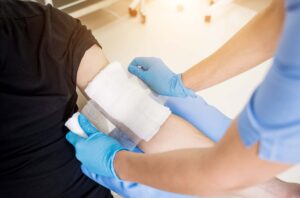 Moist wound healing consists of several stages, each of which contributes to a faster and more effective healing process.
As referenced above, the traditional dry wound healing method involved exposing the wound to air, keeping it uncovered, and allowing it to scab over. However, research has shown that in many cases, moist wound healing offers significant advantages over this approach.
According to a paper published in ‘Advances in Wound Care’, “A moist environment has been proven to facilitate the healing process of the wound by preventing dehydration and enhancing angiogenesis and collagen synthesis together with increased breakdown of dead tissue and fibrin.”
Another paper on moist wound healing published in 2021 concluded “Many studies have demonstrated that healing in a moist environment results in less inflammation than in a dry environment and thus also improves the quality of healing (less scarring).”
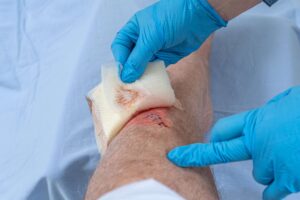 Maintaining a moist wound environment requires proper wound care and the use of appropriate wound dressings. Below are a few guidelines and tips to help keep a wound moist. That said, it’s always best to consult a wound care specialist who can recommend the appropriate dressing for your circumstances and offer recommendations for proper wound care.
Moist wound dressings come in various forms, each catering to specific wound types and stages of healing. Some common examples of the different types of moist wound dressings include:
To sum up, below are some of the major benefits of maintaining a moist environment as wounds heal and how it aids in the recovery process.
While moist wound healing has numerous benefits and is generally considered the preferred approach for most wounds, there are specific scenarios where it may not be recommended. For example, for wounds with heavy exudate or excessive moisture, maintaining a moist environment may exacerbate the problem. Additionally, wounds that require regular visualization or assessment, such as deep surgical wounds or wounds with suspected foreign bodies, may benefit from a dry wound environment to enable better monitoring. In these types of cases, your wound care specialist may opt for an alternative wound management approach based on a wound assessment and your unique case.
If you or someone you know has suffered a wound or have questions about the healing process, the specialized team at West Coast Wound Center is here to help. Book an appointment at our center today and let us help put you on the path to healing and improve your quality of life.
[/fusion_text][/fusion_builder_column][fusion_builder_column type=”1_3″ layout=”1_3″ spacing=”” center_content=”no” link=”” target=”_self” min_height=”” hide_on_mobile=”small-visibility,medium-visibility,large-visibility” class=”” id=”” hover_type=”none” border_color=”” border_style=”solid” border_position=”all” border_radius=”” box_shadow=”no” dimension_box_shadow=”” box_shadow_blur=”0″ box_shadow_spread=”0″ box_shadow_color=”” box_shadow_style=”” padding_top=”” padding_right=”” padding_bottom=”” padding_left=”” margin_top=”” margin_bottom=”” background_type=”single” gradient_start_color=”” gradient_end_color=”” gradient_start_position=”0″ gradient_end_position=”100″ gradient_type=”linear” radial_direction=”center center” linear_angle=”180″ background_color=”” background_image=”” background_image_id=”” background_position=”left top” background_repeat=”no-repeat” background_blend_mode=”none” animation_type=”” animation_direction=”left” animation_speed=”0.3″ animation_offset=”” filter_type=”regular” filter_hue=”0″ filter_saturation=”100″ filter_brightness=”100″ filter_contrast=”100″ filter_invert=”0″ filter_sepia=”0″ filter_opacity=”100″ filter_blur=”0″ filter_hue_hover=”0″ filter_saturation_hover=”100″ filter_brightness_hover=”100″ filter_contrast_hover=”100″ filter_invert_hover=”0″ filter_sepia_hover=”0″ filter_opacity_hover=”100″ filter_blur_hover=”0″ last=”true” border_sizes_top=”0″ border_sizes_bottom=”0″ border_sizes_left=”0″ border_sizes_right=”0″ first=”false” spacing_left=”1.3333333333333333%”][fusion_widget_area name=”avada-blog-sidebar” title_size=”” title_color=”” background_color=”” padding_top=”” padding_right=”” padding_bottom=”” padding_left=”” hide_on_mobile=”small-visibility,medium-visibility,large-visibility” class=”” id=”” /][/fusion_builder_column][/fusion_builder_row][/fusion_builder_container]
[fusion_builder_container hundred_percent=”no” equal_height_columns=”no” menu_anchor=”” hide_on_mobile=”small-visibility,medium-visibility,large-visibility” class=”” id=”” background_color=”” background_image=”” background_position=”center center” background_repeat=”no-repeat” fade=”no” background_parallax=”none” parallax_speed=”0.3″ video_mp4=”” video_webm=”” video_ogv=”” video_url=”” video_aspect_ratio=”16:9″ video_loop=”yes” video_mute=”yes” overlay_color=”” video_preview_image=”” border_color=”” border_style=”solid” padding_top=”” padding_bottom=”” padding_left=”” padding_right=”” type=”legacy” admin_toggled=”no”][fusion_builder_row][fusion_builder_column type=”2_3″ layout=”1_1″ background_position=”left top” background_color=”” border_color=”” border_style=”solid” border_position=”all” spacing=”yes” background_image=”” background_repeat=”no-repeat” padding_top=”” padding_right=”” padding_bottom=”” padding_left=”” margin_top=”0px” margin_bottom=”0px” class=”” id=”” animation_type=”” animation_speed=”0.3″ animation_direction=”left” hide_on_mobile=”small-visibility,medium-visibility,large-visibility” center_content=”no” last=”false” min_height=”” hover_type=”none” link=”” border_sizes_top=”” border_sizes_bottom=”” border_sizes_left=”” border_sizes_right=”” first=”true” spacing_right=”2.6666666666666665%”][fusion_text columns=”” column_min_width=”” column_spacing=”” rule_style=”default” rule_size=”” rule_color=”” content_alignment_medium=”” content_alignment_small=”” content_alignment=”” hide_on_mobile=”small-visibility,medium-visibility,large-visibility” sticky_display=”normal,sticky” class=”” id=”” margin_top=”” margin_right=”” margin_bottom=”” margin_left=”” font_size=”” fusion_font_family_text_font=”” fusion_font_variant_text_font=”” line_height=”” letter_spacing=”” text_color=”” animation_type=”” animation_direction=”left” animation_speed=”0.3″ animation_offset=””]
Surgery doesn’t always end at the operating table. The procedure can leave you with a surgical wound (incision) to care for. A surgical wound refers to any incision made by a surgeon that has resulted in a wound or hasn’t healed properly. And the last thing you want is an infection to develop.
Most incisions heal within a couple of weeks and although your wound care specialist will provide detailed guidelines, surgical wounds still require careful oversight and wound care to minimize scars, discomfort, pain, and in the worst-case scenario, an infection.
Surgical wounds are generally closed with staples, tissue glue, stitches, and Steri-Strips (special adhesive tape). Even so, there may be occasions when the incision breaks open. That’s why it’s of the utmost importance to educate yourself on proper wound care and management techniques to avoid any complications after surgery.
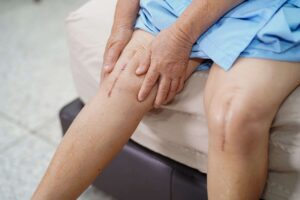 Wound care after surgery plays an important role in the recovery process; helping prevent infection, reducing scarring, and promoting healing. Generally speaking, proper wound care following surgery involves:
In light of its importance, throughout this guide, we take a more in-depth look at the proper way to care for surgical wounds after a procedure and the crucial steps to take to help keep your injury clean and safe as it heals.
Generally, there are three ways in which surgical wounds heal:
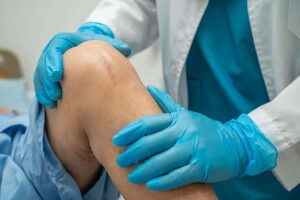 Incisions may vary in depth and width, and your wound care specialist can provide personalized guidelines for caring for them depending on your individual situation. In any case, it’s recommended to ensure the surgical wound doesn’t become wet within the first 24 hours following surgery. As such, it’s best to avoid showers or baths. If you must, a sponge bath may be a viable option.
After 24 hours, it is up to your wound specialist whether it is okay to start rinsing your wound with water, depending on the type of operation you had and the site of the wound. If the doctor allows it, opt for a shower over a bath to prevent soaking the wound, which can soften and cause it to open.
If your doctor still recommends avoiding showers you can try covering it with a plastic bag to keep it dry.
Remove any incision dressings before you shower, unless your dressing is waterproof or you are instructed otherwise. You can gently rinse the incision with water as you shower, but try not to scrub or rub the wound or apply shampoo, lotion, or other bath products.
Incisions require regular cleaning so that they don’t develop into a nidus for bacterial growth. To start, it’s recommended to clean the skin around the injury with a gauze pad or a soft cloth soaked in mild soapy water or a saline solution (salt and water mixture).
Gently dab and wipe the skin (instead of rubbing it) to get rid of any dried blood, fluids from the wound, and other matter accumulated on the skin.
Avoid Hydrogen peroxide, iodine, soap containing antibacterial chemicals, rubbing alcohol, and skin cleansers to minimize tissue damage.
When cleaning the wound itself, the procedure is generally the same. Gently wash it with soap and water to remove the crust without scrubbing or soaking it.
You can air-dry or pat the area with a clean towel before changing the dressing. Like the skin surrounding the wound, lotions, creams, and herbal remedies should be avoided, unless specifically instructed by your healthcare practitioner or wound care specialist.
In some cases, your specialist may recommend washing out or irrigating the wound, which is usually done with a syringe full of saline or soapy water.
 Another name for a bandage, a dressing creates an ideal environment for healing by absorbing drainage and preventing skin closure before the wound has successfully filled in. Wound dressings minimize the risk of infection, protect against germs, and cover the wound so stitches/staples do not catch onto clothing among other things.
Given its importance to the healing process, it is not only crucial to regularly change your dressings but it also needs to be done the right way. Your wound specialist will provide specific instructions on when and how often to change your dressing. While most wounds might not need to remain covered for extended periods, keeping it covered is still a good idea to protect the injury.
Although, you should ask your wound specialist for detailed instructions, here are a few tips for changing wound dressings you can follow:
Remember to make sure to take any jewelry off your hands and clean them with water (you can add an alcohol-based cleanser) beforehand. Ensure you clean under your nails as well, and grab all required supplies, which can include:
Once you have opened the gauze packages, cut new tape strips and put on clean medical gloves, loosen the tape around the old dressing and gently pull it off. If it sticks to the wound, you can try wetting it unless you have been specifically instructed to remove it dry.
After doing so, clean the incision as described above. Look for any signs of infection, and if your physician has asked you to apply an ointment or medicine, you can do so now.
Next, open the gauze package without touching the gauze. Hold it by the corner and place it over the surgical wound before taping all four sides. You can dispose of the trash, including the old dressing, in a plastic bag before washing your hands again.
Avoid touching the inside of the dressing, old or new.
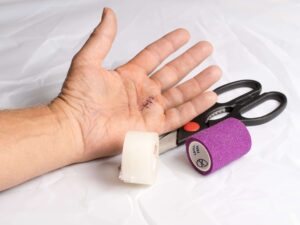 In most cases, some degree of redness, swelling, and itching around the wound site following getting stitches is normal. For the first few days, you might also see some drainage around the area. However, if this continues or if it starts to bleed or pus, get in touch with your wound care specialist as soon as possible.
When it comes to wound care for stitches or staples, they generally require the same cleaning instructions as above. Some stitches dissolve within 7 to 10 days. And non-dissolvable ones are removed by a doctor usually 5 to 21 days after the surgery. Never attempt to remove stitches on your own.
On the contrary, if tissue glue was used, it’s important to keep it dry. If it gets wet, dry it immediately, as moisture may limit its efficacy. It will dry out and take care of itself in about 5 to 10 days. Similarly, adhesive strips should also loosen and fall off over time.
As we referenced earlier, after a surgical procedure, it’s crucial to regularly check the wound for any signs of infection so it can be treated as soon as possible.
Infection is always a risk after surgery but it’s even more important to be wary of if you have conditions such as diabetes, a weak immune system, obesity, a history of smoking, or other risk factors that could impair healing.
If you notice any of the following signs contact a doctor or wound care specialist as soon as possible:
Temperature higher than 100.5°F (38°C) for more than 4 hours can also be a cause of concern.
Depending on the type of surgery, your specialist may give you other specific instructions. Make sure to follow them carefully and ask any questions you might have. That said, in addition to the guidelines discussed above, there are a few steps wound care specialists recommend taking after a surgical procedure to help the healing process:
Most people recover from surgical wounds with minimal scarring. If you would like to learn more about minimizing scarring we highly recommend our guide discussing wound care and healing scars.
Proper wound care after surgery is essential to efficient healing and recovery. By following your wound care specialists’ advice for cleaning and dressing your wound, and preventing complications you can help promote healing and even reduce scarring.
If you recently have had surgery or are caring for someone who has and have questions on proper wound care; the specialists at West Coast Wound Center are here to help. We are specialized wound and skin care physicians with expertise in treating a complete range of wound types and skin concerns. Book an appointment today and find out how we can help restore your quality of life.
[/fusion_text][/fusion_builder_column][fusion_builder_column type=”1_3″ layout=”1_3″ spacing=”” center_content=”no” link=”” target=”_self” min_height=”” hide_on_mobile=”small-visibility,medium-visibility,large-visibility” class=”” id=”” hover_type=”none” border_color=”” border_style=”solid” border_position=”all” border_radius=”” box_shadow=”no” dimension_box_shadow=”” box_shadow_blur=”0″ box_shadow_spread=”0″ box_shadow_color=”” box_shadow_style=”” padding_top=”” padding_right=”” padding_bottom=”” padding_left=”” margin_top=”” margin_bottom=”” background_type=”single” gradient_start_color=”” gradient_end_color=”” gradient_start_position=”0″ gradient_end_position=”100″ gradient_type=”linear” radial_direction=”center center” linear_angle=”180″ background_color=”” background_image=”” background_image_id=”” background_position=”left top” background_repeat=”no-repeat” background_blend_mode=”none” animation_type=”” animation_direction=”left” animation_speed=”0.3″ animation_offset=”” filter_type=”regular” filter_hue=”0″ filter_saturation=”100″ filter_brightness=”100″ filter_contrast=”100″ filter_invert=”0″ filter_sepia=”0″ filter_opacity=”100″ filter_blur=”0″ filter_hue_hover=”0″ filter_saturation_hover=”100″ filter_brightness_hover=”100″ filter_contrast_hover=”100″ filter_invert_hover=”0″ filter_sepia_hover=”0″ filter_opacity_hover=”100″ filter_blur_hover=”0″ last=”true” border_sizes_top=”0″ border_sizes_bottom=”0″ border_sizes_left=”0″ border_sizes_right=”0″ first=”false” spacing_left=”1.3333333333333333%”][fusion_widget_area name=”avada-blog-sidebar” title_size=”” title_color=”” background_color=”” padding_top=”” padding_right=”” padding_bottom=”” padding_left=”” hide_on_mobile=”small-visibility,medium-visibility,large-visibility” class=”” id=”” /][/fusion_builder_column][/fusion_builder_row][/fusion_builder_container]
[fusion_builder_container hundred_percent=”no” equal_height_columns=”no” menu_anchor=”” hide_on_mobile=”small-visibility,medium-visibility,large-visibility” class=”” id=”” background_color=”” background_image=”” background_position=”center center” background_repeat=”no-repeat” fade=”no” background_parallax=”none” parallax_speed=”0.3″ video_mp4=”” video_webm=”” video_ogv=”” video_url=”” video_aspect_ratio=”16:9″ video_loop=”yes” video_mute=”yes” overlay_color=”” video_preview_image=”” border_color=”” border_style=”solid” padding_top=”” padding_bottom=”” padding_left=”” padding_right=”” type=”legacy” admin_toggled=”no”][fusion_builder_row][fusion_builder_column type=”2_3″ layout=”1_1″ background_position=”left top” background_color=”” border_color=”” border_style=”solid” border_position=”all” spacing=”yes” background_image=”” background_repeat=”no-repeat” padding_top=”” padding_right=”” padding_bottom=”” padding_left=”” margin_top=”0px” margin_bottom=”0px” class=”” id=”” animation_type=”” animation_speed=”0.3″ animation_direction=”left” hide_on_mobile=”small-visibility,medium-visibility,large-visibility” center_content=”no” last=”false” min_height=”” hover_type=”none” link=”” border_sizes_top=”” border_sizes_bottom=”” border_sizes_left=”” border_sizes_right=”” first=”true” spacing_right=”2.6666666666666665%”][fusion_text columns=”” column_min_width=”” column_spacing=”” rule_style=”default” rule_size=”” rule_color=”” content_alignment_medium=”” content_alignment_small=”” content_alignment=”” hide_on_mobile=”small-visibility,medium-visibility,large-visibility” sticky_display=”normal,sticky” class=”” id=”” margin_top=”” margin_right=”” margin_bottom=”” margin_left=”” font_size=”” fusion_font_family_text_font=”” fusion_font_variant_text_font=”” line_height=”” letter_spacing=”” text_color=”” animation_type=”” animation_direction=”left” animation_speed=”0.3″ animation_offset=””]
Burn wounds are a common occurrence for everyone. Be it contact with flame, chemicals, electricity, or wet sources like steam or hot water, burns can happen at any time. Therefore, it is critical to understand emergency management for burns and be aware of safety measures to ensure quick recovery in case of an accident.
Small burns are often not life-threatening, but larger burns can impose a significant risk in addition to being extremely painful. According to a recent review “Acute thermal injuries requiring medical treatment affect nearly half a million Americans each year, with approximately 40,000 hospitalizations and 3,400 deaths annually.”
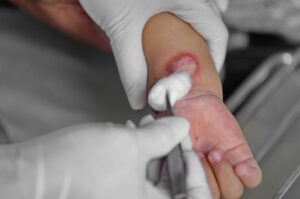 When examining burns, wound care specialists prioritize critical patients by classifying the type of burn and stabilizing the patient, cleansing, and debridement to prevent infections and focusing on full functional recovery.
It’s important to be able to recognize the severity and type of burn you have, so you not only know when it’s time to seek professional support but also how to care for your wound at home.
Burns can be classified based on how deep they penetrate the skin’s surface and the size of the burn.
It’s important to note that it is possible to suffer from more than one level of burn depth. As such, multiple approaches to wound management might be necessary. Your wound care specialist will perform an initial assessment to evaluate your burn and determine the appropriate treatment plan.
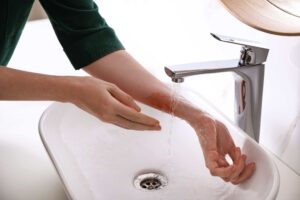 First-degree burns are common and though you can typically care for them at home, it is always better to have a wound care specialist take a look at the injury and guide you on its management. Seeking professional guidance is even more pertinent in cases where the injury has occurred on your face, genitals, hands, or feet.
Through proper wound care, most minor burns commonly heal within a week or two. Below are a few helpful tips for managing a minor burn and helping it heal:
If your superficial burn injury gets progressively worse, is not improving, or causes increased pain, swelling, or fever, it is important to visit a wound care center or consult with a specialist.
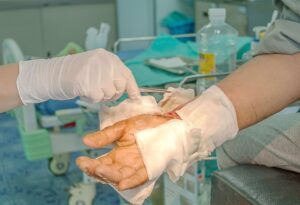 Though there is overlap in treatments for a first degree burn, you need to be more careful when dealing with these kinds of more serious burns. When it comes to burn management, the priority is wound protection and preventing shock. Burn shock occurs when the body’s tissues do not receive enough oxygen in the blood, causing low blood pressure, hypovolemia, and may result in organ failure. Hence, the blood pressure, pulse, and breathing rate should be checked continuously.
Unless you have suffered a neck, head, or leg injury, it’s recommended to lay flat, with feet and the burnt area elevated, and cover the wound to minimize air contact. A blanket or coat can be used to help stabilize core temperature.
After first aid and a thorough wound assessment are conducted, burn treatment can include multiple approaches such as lotions and medications, appropriate wound dressings, and potentially even surgery. Some of the goals of treatment for a serious burn include:
Let’s explore some of the wound care approaches commonly utilized to achieve those goals and encourage healing:
Try to avoid scratching or bumping into things as your burn heals, as it can cause skin tears. If it does occur and begins to bleed you can apply pressure for a few minutes until the bleeding stops and gently run the area under water. Antibiotic ointment and nonstick dressings can be used to promote healing. If the area becomes red or shows any sign of infection, you should contact a doctor or wound care specialist as soon as possible.
When it comes to more serious burns, there are different opinions as to how to manage blisters. Some experts recommend debriding blisters, while others are in favor of leaving them intact during healing. Your wound specialist can recommend the appropriate approach based on your individual situation.
When heat is inflicted on the skin it can cause serious damage. Knowing when it’s time to seek help from a wound care center and educating yourself on how to properly care for your burn can be essential to effective and efficient healing.
If you or someone you love has suffered a burn, the specialists at West Coast Wound Center can help, no matter how severe. We provide a full spectrum of wound care, including advanced therapies. Book an appointment today and discover how we can help you heal and improve your quality of life.
[/fusion_text][/fusion_builder_column][fusion_builder_column type=”1_3″ layout=”1_3″ spacing=”” center_content=”no” link=”” target=”_self” min_height=”” hide_on_mobile=”small-visibility,medium-visibility,large-visibility” class=”” id=”” hover_type=”none” border_color=”” border_style=”solid” border_position=”all” border_radius=”” box_shadow=”no” dimension_box_shadow=”” box_shadow_blur=”0″ box_shadow_spread=”0″ box_shadow_color=”” box_shadow_style=”” padding_top=”” padding_right=”” padding_bottom=”” padding_left=”” margin_top=”” margin_bottom=”” background_type=”single” gradient_start_color=”” gradient_end_color=”” gradient_start_position=”0″ gradient_end_position=”100″ gradient_type=”linear” radial_direction=”center center” linear_angle=”180″ background_color=”” background_image=”” background_image_id=”” background_position=”left top” background_repeat=”no-repeat” background_blend_mode=”none” animation_type=”” animation_direction=”left” animation_speed=”0.3″ animation_offset=”” filter_type=”regular” filter_hue=”0″ filter_saturation=”100″ filter_brightness=”100″ filter_contrast=”100″ filter_invert=”0″ filter_sepia=”0″ filter_opacity=”100″ filter_blur=”0″ filter_hue_hover=”0″ filter_saturation_hover=”100″ filter_brightness_hover=”100″ filter_contrast_hover=”100″ filter_invert_hover=”0″ filter_sepia_hover=”0″ filter_opacity_hover=”100″ filter_blur_hover=”0″ last=”true” border_sizes_top=”0″ border_sizes_bottom=”0″ border_sizes_left=”0″ border_sizes_right=”0″ first=”false” spacing_left=”1.3333333333333333%”][fusion_widget_area name=”avada-blog-sidebar” title_size=”” title_color=”” background_color=”” padding_top=”” padding_right=”” padding_bottom=”” padding_left=”” hide_on_mobile=”small-visibility,medium-visibility,large-visibility” class=”” id=”” /][/fusion_builder_column][/fusion_builder_row][/fusion_builder_container]
[fusion_builder_container hundred_percent=”no” equal_height_columns=”no” menu_anchor=”” hide_on_mobile=”small-visibility,medium-visibility,large-visibility” class=”” id=”” background_color=”” background_image=”” background_position=”center center” background_repeat=”no-repeat” fade=”no” background_parallax=”none” parallax_speed=”0.3″ video_mp4=”” video_webm=”” video_ogv=”” video_url=”” video_aspect_ratio=”16:9″ video_loop=”yes” video_mute=”yes” overlay_color=”” video_preview_image=”” border_color=”” border_style=”solid” padding_top=”” padding_bottom=”” padding_left=”” padding_right=”” type=”legacy” admin_toggled=”no”][fusion_builder_row][fusion_builder_column type=”2_3″ layout=”1_1″ background_position=”left top” background_color=”” border_color=”” border_style=”solid” border_position=”all” spacing=”yes” background_image=”” background_repeat=”no-repeat” padding_top=”” padding_right=”” padding_bottom=”” padding_left=”” margin_top=”0px” margin_bottom=”0px” class=”” id=”” animation_type=”” animation_speed=”0.3″ animation_direction=”left” hide_on_mobile=”small-visibility,medium-visibility,large-visibility” center_content=”no” last=”false” min_height=”” hover_type=”none” link=”” border_sizes_top=”” border_sizes_bottom=”” border_sizes_left=”” border_sizes_right=”” first=”true” spacing_right=”2.6666666666666665%”][fusion_text columns=”” column_min_width=”” column_spacing=”” rule_style=”default” rule_size=”” rule_color=”” content_alignment_medium=”” content_alignment_small=”” content_alignment=”” hide_on_mobile=”small-visibility,medium-visibility,large-visibility” sticky_display=”normal,sticky” class=”” id=”” margin_top=”” margin_right=”” margin_bottom=”” margin_left=”” font_size=”” fusion_font_family_text_font=”” fusion_font_variant_text_font=”” line_height=”” letter_spacing=”” text_color=”” animation_type=”” animation_direction=”left” animation_speed=”0.3″ animation_offset=””]
 Pressure ulcers also referred to as bedsores, pressure injuries, and decubitus ulcers occur when areas of the skin break down due to prolonged pressure that lowers the blood flow to the area. Pressure ulcers are a common problem for older adults, wheelchair users, or those in a hospital bed for an extended amount of time without movement.
Although pressure ulcers can happen anywhere on the body, they usually occur on the more bony parts of the body including the hips, back, elbows, heels of the feet, ankles, shoulder blades, tailbone, and the back of the head. For some, pressure ulcers can be uncomfortable and interfere with quality of life, for others they can be even more dangerous and potentially life-threatening if not cared for. Fortunately, most pressure sores can be treated and through proper wound care even prevented.
Pressure ulcers are a type of slow healing wound caused by prolonged pressure that reduces blood flow or friction that can make the skin more fragile. Some of the people who might be at added risk of developing pressure ulcers include:
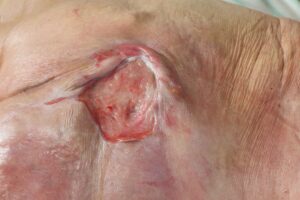 Pressure ulcers are generally categorized into four stages depending on how deep the wound is and the severity of the symptoms. Categorizing the wound into these stages can help wound care specialists determine the right course of treatment.
Although less common, deep pressure injury and unstageable sores are two types of severe pressure ulcers that don’t fall into the above stages. These types of ulcers can be more difficult to diagnose and should be addressed by a specialist.
Development and treatment of pressure ulcers depend upon the care you receive. Diagnosis is followed by ulcer staging which, in conjunction with the degree of pain and time of onset, helps determines the course of wound care.
A multi-pronged approach of lowering pressure on injured areas, thoroughly cleaning the wound, managing pain, preventing further infection, and ensuring dietary care is an ideal way to deal with pressure ulcers.
Since pressure ulcers develop from prolonged friction, minimizing the source prevents the condition from worsening and the formation of new ones. This can be achieved through regular repositioning and using better support surfaces like specialized mattresses and cushions.
Changing your position frequently can help avoid making pressure ulcers worse. How often you need to reposition yourself will depend on your circumstances as well as what type of surface you are on. For example, wheelchair users are advised to change position every fifteen minutes, whereas bedridden people should try to reposition every two hours. Devising a repositioning schedule based on the severity of your injury and the type of material you lay on can help make sure you stay on track.
There is specialized equipment to help alleviate pressure on the wound site. A specially designed dynamic mattress or static foam is typically used for bedsores due to its pressure redistribution capabilities.
Special pillows, booties, mattress pads, and foam cushions are available, with some being water or air-filled for a more comfortable experience. If your ulcer is very severe, a sophisticated system with an air pump may be recommended by your doctor.
Do not blindly purchase any mattress online because the best cushion depends on your ulcer, whether you are in a wheelchair or a bed, as well as other factors. Shape and material options also vary according to need and preference. Consult with your wound care specialist for recommendations on what you might need.
 While stage 3 and 4 pressure ulcers should be cleaned and treated by a wound care specialist, there are things you can do to care for wounds that are in the first two stages. That said, it’s still recommended to seek professional guidance on proper caring methods.
Added pressure can cause the ulcer to break the skin, so the first step in treating a pressure ulcer is to alleviate excess pressure. Using blankets or pillows can be helpful if you are lying down. Try to keep the wound site clean and dry.
Gently washing the area with mild soap and water is sufficient to help a Stage I sore, while saline (salt water) or specific cleaner can be used for Stage II sores to remove loose, dead tissue. Avoid using hydrogen peroxide and iodine cleansers that could further damage the skin.
A wound care specialist may recommend wound dressings that can help keep the site clean and dry to avoid infection. Depending on the wound and its severity, your specialist may recommend a specific type of dressing to use.
Though the right dressing depends upon the size and stage of your ulcer, gauze dressings are not advised for this situation. Instead, specially designed dressings like those made from alginate (with seaweed, containing sodium and calcium), hydrocolloid (with a gel that enhances cellular growth), and hydrofibers are often used.
A specialist can also walk you through the proper way to dress your wound. It’s also important to be on the lookout for any signs of infection.
As referenced above, it’s crucial to seek professional support as soon as possible if you have a stage 3 or 4 pressure ulcer. The more severe the wound, the higher the risk of infection. If your ulcer is categorized as stage 3, your specialist might recommend antibiotics if there is an infection and wound debridement to prevent infection and facilitate healing. Stage 4 pressure ulcers require immediate medical attention and could require additional interventions like surgical options.
While in some cases, it can be difficult to prevent pressure ulcers from developing, there are certain steps that you can put into place to help lower your risk.
Finally, you should contact a physician as soon as you feel the situation is out of your control. For example, if new sores develop, your current one changes or you see any sign of infection. Some of the signs to watch out for include pus, foul smell, redness and tenderness around the sore, and fever. You should not wait until the situation gets worse.
Without proper care, most pressure ulcers only get worse. That’s why it’s crucial to let your wound care specialist know if you spot any signs of one developing. They can help recommend and execute the best course of treatment to facilitate healing and help prevent them from coming back.
If you or someone you care for have suffered a serious wound or is at risk of developing a pressure ulcer the expert team at West Coast Wound Center is here to help. The specialized physicians and medical staff at our wound care center in Fresno are equipped to treat a complete range of wound types and skin concerns including pressure ulcers and bedsores.
Through our fully integrated wound and dermatology care, we are able to heal pressure ulcers 50% quicker than other practices.
Book an appointment at West Coast Wound Center today and let us help you heal and restore your quality of life.
[/fusion_text][/fusion_builder_column][fusion_builder_column type=”1_3″ layout=”1_3″ spacing=”” center_content=”no” link=”” target=”_self” min_height=”” hide_on_mobile=”small-visibility,medium-visibility,large-visibility” class=”” id=”” hover_type=”none” border_color=”” border_style=”solid” border_position=”all” border_radius=”” box_shadow=”no” dimension_box_shadow=”” box_shadow_blur=”0″ box_shadow_spread=”0″ box_shadow_color=”” box_shadow_style=”” padding_top=”” padding_right=”” padding_bottom=”” padding_left=”” margin_top=”” margin_bottom=”” background_type=”single” gradient_start_color=”” gradient_end_color=”” gradient_start_position=”0″ gradient_end_position=”100″ gradient_type=”linear” radial_direction=”center center” linear_angle=”180″ background_color=”” background_image=”” background_image_id=”” background_position=”left top” background_repeat=”no-repeat” background_blend_mode=”none” animation_type=”” animation_direction=”left” animation_speed=”0.3″ animation_offset=”” filter_type=”regular” filter_hue=”0″ filter_saturation=”100″ filter_brightness=”100″ filter_contrast=”100″ filter_invert=”0″ filter_sepia=”0″ filter_opacity=”100″ filter_blur=”0″ filter_hue_hover=”0″ filter_saturation_hover=”100″ filter_brightness_hover=”100″ filter_contrast_hover=”100″ filter_invert_hover=”0″ filter_sepia_hover=”0″ filter_opacity_hover=”100″ filter_blur_hover=”0″ last=”true” border_sizes_top=”0″ border_sizes_bottom=”0″ border_sizes_left=”0″ border_sizes_right=”0″ first=”false” spacing_left=”1.3333333333333333%”][fusion_widget_area name=”avada-blog-sidebar” title_size=”” title_color=”” background_color=”” padding_top=”” padding_right=”” padding_bottom=”” padding_left=”” hide_on_mobile=”small-visibility,medium-visibility,large-visibility” class=”” id=”” /][/fusion_builder_column][/fusion_builder_row][/fusion_builder_container]
[fusion_builder_container hundred_percent=”no” equal_height_columns=”no” menu_anchor=”” hide_on_mobile=”small-visibility,medium-visibility,large-visibility” class=”” id=”” background_color=”” background_image=”” background_position=”center center” background_repeat=”no-repeat” fade=”no” background_parallax=”none” parallax_speed=”0.3″ video_mp4=”” video_webm=”” video_ogv=”” video_url=”” video_aspect_ratio=”16:9″ video_loop=”yes” video_mute=”yes” overlay_color=”” video_preview_image=”” border_color=”” border_style=”solid” padding_top=”” padding_bottom=”” padding_left=”” padding_right=”” type=”legacy” admin_toggled=”no”][fusion_builder_row][fusion_builder_column type=”2_3″ layout=”1_1″ background_position=”left top” background_color=”” border_color=”” border_style=”solid” border_position=”all” spacing=”yes” background_image=”” background_repeat=”no-repeat” padding_top=”” padding_right=”” padding_bottom=”” padding_left=”” margin_top=”0px” margin_bottom=”0px” class=”” id=”” animation_type=”” animation_speed=”0.3″ animation_direction=”left” hide_on_mobile=”small-visibility,medium-visibility,large-visibility” center_content=”no” last=”false” min_height=”” hover_type=”none” link=”” border_sizes_top=”” border_sizes_bottom=”” border_sizes_left=”” border_sizes_right=”” first=”true” spacing_right=”2.6666666666666665%”][fusion_text columns=”” column_min_width=”” column_spacing=”” rule_style=”default” rule_size=”” rule_color=”” content_alignment_medium=”” content_alignment_small=”” content_alignment=”” hide_on_mobile=”small-visibility,medium-visibility,large-visibility” sticky_display=”normal,sticky” class=”” id=”” margin_top=”” margin_right=”” margin_bottom=”” margin_left=”” font_size=”” fusion_font_family_text_font=”” fusion_font_variant_text_font=”” line_height=”” letter_spacing=”” text_color=”” animation_type=”” animation_direction=”left” animation_speed=”0.3″ animation_offset=””]
Healthcare professionals have used compression therapy to help heal wounds and treat inflammation for centuries. This well-established approach to wound care is the go-to treatment for venous and leg ulcers due to its wide range of applications and benefits. In fact, according to Advances in Skin & Wound Care “Between 50% and 60% of patients heal with compression therapy alone during a 6-month period”.
In light of its crucial role in the healing process, throughout this guide, we will explore how compression therapy works and why it has become so widely used by wound care specialists as another tool to help patients recover.
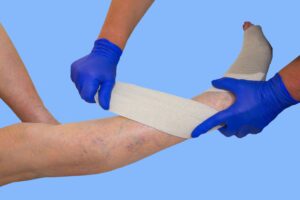 Compression therapy is a treatment approach that involves the use of bandages or other wound compression products to improve blood flow circulation in the lower legs. By adding pressure with wraps, it helps prevent fluid buildup, reduce venous pressure and edema, and aids the body in moving blood around.
A wound care specialist may recommend compression therapy for a number of different injuries caused by poor circulation such as:
Let’s take a look at each of these conditions and how compression therapy can help the healing process.
 There are a number of reasons why healthcare professionals might utilize compression therapy for circulatory wounds. Some of the major benefits associated with this form of therapy include:
Chronic venous insufficiency is a common condition. Our leg veins contain valves that help ensure blood moves back up to the heart. When these valves become damaged or weakened it impairs the process, resulting in blood to build up in the legs. If left untreated, the added pressure and decreased range of motion can result in venous ulcers.
By applying appropriate pressure to the leg muscles, compression therapy can help push blood back toward the heart and reduce chronic venous insufficiency.
Compression therapy can also help relieve inflammation and pain associated with varicose veins; a condition that often results from chronic venous insufficiency.
Sitting or standing for a prolonged period of time for example after a long flight or forced to stand for work, can impact how blood flows back to the heart. Compression therapy squeezes the leg to help blood flow faster and go where it’s supposed to.
By helping your body absorb extra fluid in your legs compression therapy can be helpful in treating edema, where fluid builds up resulting in inflammation throughout the legs and ankles. Compression wrapping can also help reduce swelling if you have had leg or knee surgery.
Orthostatic hypotension is a condition that results from poor blood flow to the heart when you stand up. This can lead to symptoms such as feeling dizzy, lightheaded, or nauseous. In some cases, wound specialists will recommend compression therapy to prevent blood from collecting in your legs (the primary cause of orthostatic hypotension) and avoid these symptoms.
Deep vein thrombosis (DVT) is a condition caused when a blood clot develops in the veins resulting in inflammation and blood to build up. If left untreated, DVT can result in serious complications. Fortunately, compression therapy can also lower the risk of blood clots forming.
Additionally, those that travel long distances can also be at greater risk of blood clots. Wearing compression socks can lower your risk.
Leg ulcers are open wounds that can take a long time to heal. There are a number of conditions where leg ulcers are common including:
Compression therapy is one of the most common approaches to treating leg ulcers. By improving blood flow, compression therapy helps wounds heal more effectively, reduces symptoms including pain and itching, and can help prevent new ones from forming.
Compression therapy has also shown promise in:
There is no one type of compression therapy that works for everyone and it should be avoided for some types of wounds. For example, it isn’t recommended if you are suffering from peripheral arterial disease, heart failure as well as other conditions. Your wound care specialist will assess your condition to determine if it’s the right choice and help ensure no complications arise.
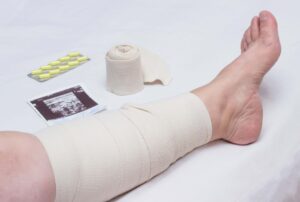 There are several types of compression products that may be used for wound healing. These products are typically broken down by the level of compression they offer. The type you need will depend on your injury and how much compression is required. Generally, less severe conditions such as before a long flight or aching legs require lower levels of pressure, while a higher level of pressure is used to treat acute issues including edema or addressing wounds and ulcers.
Compression bandages are typically broken down into Short Stretch Bandages, Long Stretch Bandages, and Multi-Layer Bandages. Long stretch bandages tend to be more elastic and capable of being stretched.
One of the major advantages of utilizing compression bandages is they can be fitted to a wide range of patients. While both short and long term bandages have unique benefits and uses, both have been shown to achieve similar results in terms of healing. Rather, how effective they are will largely depend on how they are wrapped. That’s why it’s so important to consult a trained specialist to gauge how much pressure is needed.
Once your wound has healed, your specialist may recommend compression stockings or socks to help prevent it from coming back. They will measure your legs and recommend an appropriate length (stockings usually reach the knee or thigh).
Although not as common as bandages and stockings, an intermittent pneumatic compression (IPC) system is another method of compression. IPCs utilize a pump and bladder system that are inflated and deflated on a set schedule.
Compression therapy can aid in treating certain chronic wounds, improve healing time and significantly improve overall quality of life. If you or a loved one have suffered a wound and believe you might be a good candidate for compression therapy the expert team at West Coast Wound Center can help. We provide a full spectrum of wound and skin care services, including advanced therapies such as compression devices, and have advanced knowledge in treating a wide range of wound types and skin concerns. Book an appointment today and let us help you heal.
[/fusion_text][/fusion_builder_column][fusion_builder_column type=”1_3″ layout=”1_3″ spacing=”” center_content=”no” link=”” target=”_self” min_height=”” hide_on_mobile=”small-visibility,medium-visibility,large-visibility” class=”” id=”” hover_type=”none” border_color=”” border_style=”solid” border_position=”all” border_radius=”” box_shadow=”no” dimension_box_shadow=”” box_shadow_blur=”0″ box_shadow_spread=”0″ box_shadow_color=”” box_shadow_style=”” padding_top=”” padding_right=”” padding_bottom=”” padding_left=”” margin_top=”” margin_bottom=”” background_type=”single” gradient_start_color=”” gradient_end_color=”” gradient_start_position=”0″ gradient_end_position=”100″ gradient_type=”linear” radial_direction=”center center” linear_angle=”180″ background_color=”” background_image=”” background_image_id=”” background_position=”left top” background_repeat=”no-repeat” background_blend_mode=”none” animation_type=”” animation_direction=”left” animation_speed=”0.3″ animation_offset=”” filter_type=”regular” filter_hue=”0″ filter_saturation=”100″ filter_brightness=”100″ filter_contrast=”100″ filter_invert=”0″ filter_sepia=”0″ filter_opacity=”100″ filter_blur=”0″ filter_hue_hover=”0″ filter_saturation_hover=”100″ filter_brightness_hover=”100″ filter_contrast_hover=”100″ filter_invert_hover=”0″ filter_sepia_hover=”0″ filter_opacity_hover=”100″ filter_blur_hover=”0″ last=”true” border_sizes_top=”0″ border_sizes_bottom=”0″ border_sizes_left=”0″ border_sizes_right=”0″ first=”false” spacing_left=”1.3333333333333333%”][fusion_widget_area name=”avada-blog-sidebar” title_size=”” title_color=”” background_color=”” padding_top=”” padding_right=”” padding_bottom=”” padding_left=”” hide_on_mobile=”small-visibility,medium-visibility,large-visibility” class=”” id=”” /][/fusion_builder_column][/fusion_builder_row][/fusion_builder_container]
[fusion_builder_container hundred_percent=”no” hundred_percent_height=”no” hundred_percent_height_scroll=”no” hundred_percent_height_center_content=”yes” equal_height_columns=”no” menu_anchor=”” hide_on_mobile=”small-visibility,medium-visibility,large-visibility” status=”published” publish_date=”” class=”” id=”” link_color=”” link_hover_color=”” border_color=”” border_style=”solid” margin_top=”” margin_bottom=”” padding_top=”” padding_right=”” padding_bottom=”” padding_left=”” gradient_start_color=”” gradient_end_color=”” gradient_start_position=”0″ gradient_end_position=”100″ gradient_type=”linear” radial_direction=”center center” linear_angle=”180″ background_color=”” background_image=”” background_position=”center center” background_repeat=”no-repeat” fade=”no” background_parallax=”none” enable_mobile=”no” parallax_speed=”0.3″ background_blend_mode=”none” video_mp4=”” video_webm=”” video_ogv=”” video_url=”” video_aspect_ratio=”16:9″ video_loop=”yes” video_mute=”yes” video_preview_image=”” filter_hue=”0″ filter_saturation=”100″ filter_brightness=”100″ filter_contrast=”100″ filter_invert=”0″ filter_sepia=”0″ filter_opacity=”100″ filter_blur=”0″ filter_hue_hover=”0″ filter_saturation_hover=”100″ filter_brightness_hover=”100″ filter_contrast_hover=”100″ filter_invert_hover=”0″ filter_sepia_hover=”0″ filter_opacity_hover=”100″ filter_blur_hover=”0″ type=”legacy”][fusion_builder_row][fusion_builder_column type=”1_1″ layout=”1_1″ spacing=”” center_content=”no” link=”” target=”_self” min_height=”” hide_on_mobile=”small-visibility,medium-visibility,large-visibility” class=”” id=”” hover_type=”none” border_color=”” border_style=”solid” border_position=”all” border_radius=”” box_shadow=”no” dimension_box_shadow=”” box_shadow_blur=”0″ box_shadow_spread=”0″ box_shadow_color=”” box_shadow_style=”” padding_top=”” padding_right=”” padding_bottom=”” padding_left=”” margin_top=”” margin_bottom=”” background_type=”single” gradient_start_color=”” gradient_end_color=”” gradient_start_position=”0″ gradient_end_position=”100″ gradient_type=”linear” radial_direction=”center center” linear_angle=”180″ background_color=”” background_image=”” background_image_id=”” background_position=”left top” background_repeat=”no-repeat” background_blend_mode=”none” animation_type=”” animation_direction=”left” animation_speed=”0.3″ animation_offset=”” filter_type=”regular” filter_hue=”0″ filter_saturation=”100″ filter_brightness=”100″ filter_contrast=”100″ filter_invert=”0″ filter_sepia=”0″ filter_opacity=”100″ filter_blur=”0″ filter_hue_hover=”0″ filter_saturation_hover=”100″ filter_brightness_hover=”100″ filter_contrast_hover=”100″ filter_invert_hover=”0″ filter_sepia_hover=”0″ filter_opacity_hover=”100″ filter_blur_hover=”0″ last=”true” border_sizes_top=”0″ border_sizes_bottom=”0″ border_sizes_left=”0″ border_sizes_right=”0″ first=”true” type=”1_1″][/fusion_builder_column][fusion_builder_column type=”2_3″ layout=”2_3″ spacing=”” center_content=”no” link=”” target=”_self” min_height=”” hide_on_mobile=”small-visibility,medium-visibility,large-visibility” class=”” id=”” hover_type=”none” border_color=”” border_style=”solid” border_position=”all” border_radius=”” box_shadow=”no” dimension_box_shadow=”” box_shadow_blur=”0″ box_shadow_spread=”0″ box_shadow_color=”” box_shadow_style=”” padding_top=”” padding_right=”” padding_bottom=”” padding_left=”” margin_top=”” margin_bottom=”” background_type=”single” gradient_start_color=”” gradient_end_color=”” gradient_start_position=”0″ gradient_end_position=”100″ gradient_type=”linear” radial_direction=”center center” linear_angle=”180″ background_color=”” background_image=”” background_image_id=”” background_position=”left top” background_repeat=”no-repeat” background_blend_mode=”none” animation_type=”” animation_direction=”left” animation_speed=”0.3″ animation_offset=”” filter_type=”regular” filter_hue=”0″ filter_saturation=”100″ filter_brightness=”100″ filter_contrast=”100″ filter_invert=”0″ filter_sepia=”0″ filter_opacity=”100″ filter_blur=”0″ filter_hue_hover=”0″ filter_saturation_hover=”100″ filter_brightness_hover=”100″ filter_contrast_hover=”100″ filter_invert_hover=”0″ filter_sepia_hover=”0″ filter_opacity_hover=”100″ filter_blur_hover=”0″ last=”false” border_sizes_top=”0″ border_sizes_bottom=”0″ border_sizes_left=”0″ border_sizes_right=”0″ first=”true” spacing_right=”” type=”2_3″][fusion_text columns=”” column_min_width=”” column_spacing=”” rule_style=”default” rule_size=”” rule_color=”” content_alignment_medium=”” content_alignment_small=”” content_alignment=”” hide_on_mobile=”small-visibility,medium-visibility,large-visibility” sticky_display=”normal,sticky” class=”” id=”” font_size=”” fusion_font_family_text_font=”” fusion_font_variant_text_font=”” line_height=”” letter_spacing=”” text_color=”” animation_type=”” animation_direction=”left” animation_speed=”0.3″ animation_offset=””]
[/fusion_text][fusion_video video=”https://westcoastwound.com/wcw-training-videos/wound-dressings.mp4″ video_webm=”” width=”” controls=”yes” preload=”metadata” loop=”no” autoplay=”no” mute=”no” preview_image=”https://westcoastwound.com/wp-content/uploads/2020/07/wound-dressings.jpg” hide_on_mobile=”small-visibility,medium-visibility,large-visibility” class=”” css_id=”” overlay_color=”” border_radius_top_left=”” border_radius_top_right=”” border_radius_bottom_right=”” border_radius_bottom_left=”” box_shadow=”no” box_shadow_vertical=”” box_shadow_horizontal=”” box_shadow_blur=”0″ box_shadow_spread=”0″ box_shadow_color=”” alignment=”” margin_top=”” margin_bottom=”” /][/fusion_builder_column][fusion_global id=”1431″][/fusion_builder_row][/fusion_builder_container]