
What Does Mobile Wound Care Bring to the Bedside in South Carolina?
Mobile wound care in South Carolina dispatches board-certified wound specialists, nurse practitioners, and physician assistants directly to private residences, assisted living communities, and skilled nursing facilities (SNFs). Rather than relying on basic home-health dressing changes, mobile clinical teams perform hospital-level bedside interventions—including sharp and enzymatic debridement, non-invasive vascular assessments, targeted wound cultures, and Medicare-covered cellular and tissue-based skin substitutes (biologics)—to accelerate closure in chronic, non-healing wounds.
How Bedside Wound Care Lowers Hospital Readmissions in South Carolina
In the coastal Lowcountry, managing chronic wounds such as diabetic foot ulcers, venous stasis ulcers, and Stage III–IV pressure injuries is complicated by environmental and infrastructural realities. High subtropical humidity along the Ashley and Cooper Rivers increases peri-wound maceration risks, while frequent summer flooding, tidal king tides, and heavy congestion along the I-26 and I-526 corridors routinely delay non-emergency medical transportation (NEMT).
When an immobile patient misses even a single weekly appointment at a hospital-based outpatient department (HOPD), necrotic bioburden can rapidly escalate into cellulitis, osteomyelitis, or sepsis—triggering avoidable emergency department transfers.
By bringing physician-led protocols directly to the patient’s living space or facility bed, mobile wound care eliminates transport-induced shearing injuries, removes logistical bottlenecks, and preserves strict weekly continuity of care.
Mobile Wound Care in South Carolina Comparison Chart
| Clinical & Operational Metric | Outpatient Hospital Wound Clinic Transfers | Mobile Bedside Wound Care (South Carolina) |
| Transportation & Logistical Cost | High out-of-pocket ambulance, stretcher-van, or wheelchair transport fees per visit; significant caregiver time off work. | Zero patient transport cost; clinicians travel directly to the home, assisted living facility, or SNF. |
| Physical Stress & Shear Risk | Repeated gurney transfers, vehicle vibration, and prolonged waiting-room sitting exacerbate sacral and ischial pressure injuries. | Zero transfer trauma; patients remain offloaded on pressure-redistributing mattresses in a controlled environment. |
| Continuity of Care & Adherence | High cancellation rates due to Lowcountry weather events, I-26/US-17 traffic delays, or patient fatigue. | Consistent weekly bedside visits regardless of regional traffic or mobility barriers, ensuring uninterrupted healing. |
| Infection & Readmission Risk | Exposure to hospital-acquired pathogens in waiting areas plus delayed intervention when appointments are missed. | Early bedside detection of biofilm and localized infection via on-site cultures, dramatically lowering sepsis readmissions. |
| Facility & Caregiver Coordination | Fragmented discharge summaries; facility nurses and family caregivers rarely speak directly with the wound physician. | Real-time bedside education, live EHR documentation, and direct protocol alignment with SNF nurses and home health teams. |
Specialized Treatments Available at the Bedside
A common misconception among families and discharge planners is that advanced limb-salvage procedures require an operating room or hospital outpatient suite. Modern mobile wound care equips clinicians with portable diagnostic instruments, sterile surgical trays, and biologic therapies capable of resolving complex, stalled wounds in any residential setting.
Through integrated comprehensive wound and dermatology programs, clinical teams address both the local wound bed and the systemic factors preventing tissue regeneration.
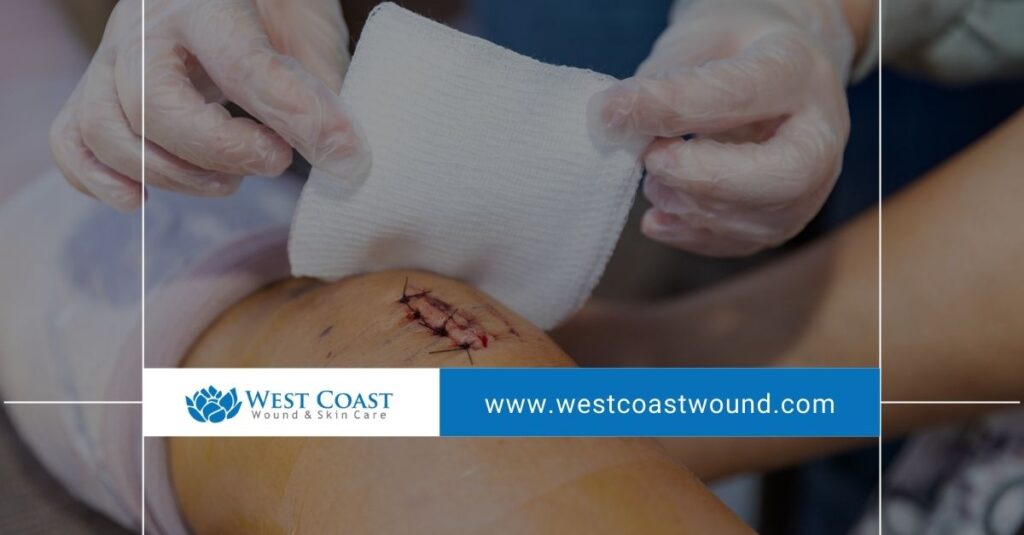
- Ultrasonic and Sharp Debridement: Removing necrotic slough, eschar, and bacterial biofilm is the cornerstone of wound bed preparation. Mobile specialists perform precise bedside sharp debridement using sterile curettes and scalpels, alongside low-frequency ultrasonic mist therapy and enzymatic agents to stimulate healthy granulation tissue without requiring hospital admission.
- Amniotic and Cellular Grafts (CTPs): When diabetic foot ulcers or venous leg ulcers stall despite standard moist wound healing, clinicians apply bio-engineered cellular and tissue-based products (CTPs) directly at the bedside. Dehydrated human amnion/chorion membrane allografts and placental-derived matrices deliver concentrated growth factors and structural scaffolding that signal dormant cells to close chronic defects.
- Multi-Layer Compression Therapy: South Carolina’s warm, humid coastal climate frequently exacerbates lower-extremity edema and chronic venous insufficiency. Following bedside Ankle-Brachial Index (ABI) vascular screening to rule out peripheral arterial disease, specialists apply tailored two-layer or four-layer compression bandaging systems to restore venous return and heal refractory venous stasis ulcers.
- Ostomy and Pressure Ulcer Management: Bedbound seniors and post-stroke patients face high risks for sacral, trochanteric, and heel pressure ulcers. Bedside clinicians conduct precise pressure-injury staging, prescribe negative-pressure wound therapy (wound VAC) protocols, manage complex ostomy skin breakdown, and train caregivers on two-hour turning schedules and moisture-barrier protection against Lowcountry humidity.
Lowcountry Communities We Serve Around Charleston
Effective mobile medical delivery depends on localized routing, rapid response times, and deep integration with regional healthcare networks. Mobile wound care teams operate across the tri-county Charleston metropolitan area—spanning Charleston, Berkeley, and Dorchester counties—to support patients aging in place as well as residents inside long-term care communities.
- Downtown Charleston & West Ashley: Serving historic peninsula residences, retirement communities, and West Ashley residential neighborhoods near Bon Secours St. Francis Hospital, ensuring post-surgical and geriatric patients transition smoothly from acute inpatient stays to home recovery.
- North Charleston & Park Circle: Providing rapid bedside consultations along the I-26 and Rivers Avenue corridors, supporting high-density skilled nursing facilities, rehabilitation centers, and homebound veterans near the Ralph H. Johnson VA outpatient network.
- Mount Pleasant & East Cooper: Delivering scheduled weekly wound and skin care across Mount Pleasant, Isle of Palms, and Sullivan’s Island, eliminating stressful bridge crossings over the Arthur Ravenel Jr. Bridge for frail seniors in assisted living and memory care communities.
- Summerville & Nexton: Extending full mobile clinical coverage northwest into Dorchester and Berkeley counties, serving rapidly growing active-adult developments, board-and-care homes, and post-acute rehab facilities throughout Summerville and Ladson.
- Goose Creek, Hanahan & Moncks Corner: Reaching patients across northern Berkeley County—including residential neighborhoods around Naval Weapons Station Charleston and Lake Moultrie—where distance from downtown hospital systems often delays specialist follow-up.
- James Island, Johns Island & Kiawah: Navigating coastal barrier islands and rural sea-island routes along Maybank Highway and Bohicket Road so isolated homebound residents receive uninterrupted vascular and wound management without multi-hour round-trip drives.
Frequently Asked Questions About Mobile Wound Care in South Carolina
Does Medicare cover mobile wound care visits in South Carolina?
Yes. Traditional Medicare Part B covers medically necessary mobile wound care visits, bedside debridement, diagnostic cultures, and qualifying cellular skin substitutes for homebound patients and residents in assisted living or skilled nursing facilities, typically covering 80% of the Medicare-approved amount after the annual deductible, with secondary or Medigap plans often covering the remaining 20%.
Medicare evaluates medical necessity based on the severity of the chronic or non-healing wound—such as diabetic ulcers, pressure injuries, venous stasis ulcers, or dehisced surgical incisions—combined with clinical documentation showing that leaving the home requires a considerable and taxing effort.
Mobile wound care practices handle insurance verification and prior authorizations for advanced biologics before initiating treatment.
How quickly can a mobile wound specialist see a patient in the Charleston area?
Most mobile wound care referrals across Charleston, North Charleston, Mount Pleasant, and Summerville are scheduled within 24 to 72 hours of receiving clinical orders, with recurring weekly bedside follow-up visits established thereafter to track wound closure and prevent infection.
Rapid initial triage is essential following a hospital discharge or skilled nursing admission. Upon receiving a referral from a primary care physician, home health agency, hospital discharge planner, or family caregiver, intake coordinators verify insurance eligibility, review recent hospital imaging or lab work, and assign a regional clinician to conduct the comprehensive baseline assessment.
Can mobile wound care work alongside existing South Carolina home health nurses?
Yes. Mobile wound care physicians and nurse practitioners collaborate directly with South Carolina home health agencies and facility nursing teams—the mobile specialist performs advanced procedures like sharp debridement and biologic grafting, while home health nurses execute interim dressing changes between weekly specialist visits.
Under Medicare guidelines, home health agencies provide skilled nursing care and routine dressing changes, whereas a mobile wound specialist acts as the consulting medical provider. Both teams share progress notes, wound measurements, and updated treatment orders so there is zero duplication of billing and complete clinical alignment around the patient’s bedside.
What types of wounds qualify for bedside treatment in South Carolina?
Any acute, chronic, or non-healing wound that has failed to show measurable signs of closure within two to four weeks qualifies for mobile wound care, including diabetic foot ulcers, Stage II–IV pressure injuries, venous and arterial leg ulcers, post-surgical dehiscence, radiation tissue damage, and traumatic skin tears.
Because coastal South Carolina’s heat and humidity can rapidly turn minor lower-extremity abrasions or venous edema into complex, infected ulcers, early specialist intervention is recommended whenever redness, drainage, odor, or stalled healing appears. Mobile clinicians evaluate underlying nutrition, blood glucose control, and peripheral circulation to resolve the root physiological barriers to healing.
